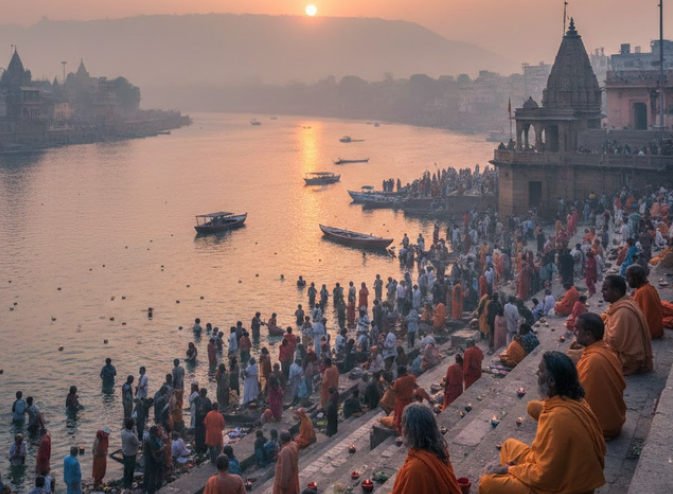
Haridwar, literally meaning “The Gateway to God”. It is one of the seven holiest cities in Hinduism and a profound epicentre of Indian spirituality. It is located where the sacred Ganges River finally descends from the Himalayas to reach the Indo-Gangetic plains. The city is a living testament to ancient rituals, vibrant temples, and timeless devotion. Furthermore also attracting devotees who believe that a dip in the Brahmakund at Har Ki Pauri can absolve their bad karma.
Whether it is the hypnotic rhythm of the evening Ganga Aarti, or the scent of incense wafting from riverside ashrams. Or its role as a host to the massive Kumbh Mela. Haridwar radiates an energy that transcends the physical, offering a direct bridge between the earthly and the eternal.
History of Haridwar
It is a holy site where, during the Samudra Manthan, the drops of amrita (elixir of immortality) fell. This makes it one of the four pilgrimage sites in Hinduism. This city is the entry point to the Char Dham. The Kumbh Mela, held every twelve years, attracts millions of people to cleanse their sins and attain Moksha. The Brahma Kund at Har ki Pauri ranks as the most sacred ghat. People believe this to be the place where the amrita fell. Also where Sage Dhaumya introduced Yudhishthira to significant pilgrimage sites.
Historically, various dynasties, including the Mauryans and the Kushans, ruled Haridwar. It flourished under King Harshvardhan, later visited by the Chinese traveller Hiuen Tsang. In 1398, Haridwar also faced an invasion by Timur, an Asian conqueror.
Known as the Gateway to God, Haridwar is a city where the air is thick with the scent of incense and the rhythmic resonance of temple bells. The temples of Haridwar are not merely architectural structures. These are vibrant spiritual hubs that bridge the gap between the earthly and the divine. From the lofty heights of the Mansa Devi and Chandi Devi hilltop shrines to the ancient, ground-level sanctums like Maya Devi. These temples represent a rich tapestry of Vedic history, Puranic legends, and intense devotion. Each site serves as a vital chapter in India’s religious legacy. Drawing millions of pilgrims who seek everything from the fulfilment of worldly desires to the ultimate liberation of the soul.
A Spiritual Overview
The Shakti Connection: Haridwar is a primary centre for Goddess worship, housing several powerful Shakti Peethas and Siddh Peethas.
The Shiva Heritage: Sites like Daksheshwar Mahadev anchor the city in the profound mysteries of Lord Shiva’s mythology.
Nationalism & Faith: Modern additions, such as the Bharat Mata Mandir. A blend of traditional worship with a celebration of India’s cultural and geographical identity.
Mansa Devi Mandir
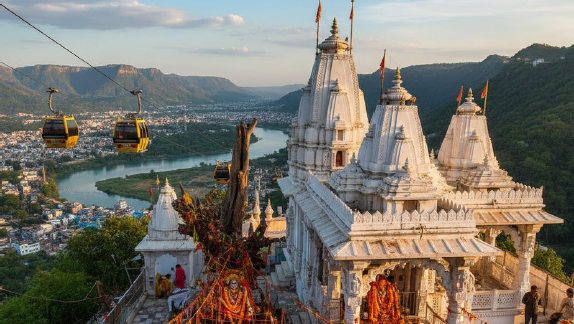
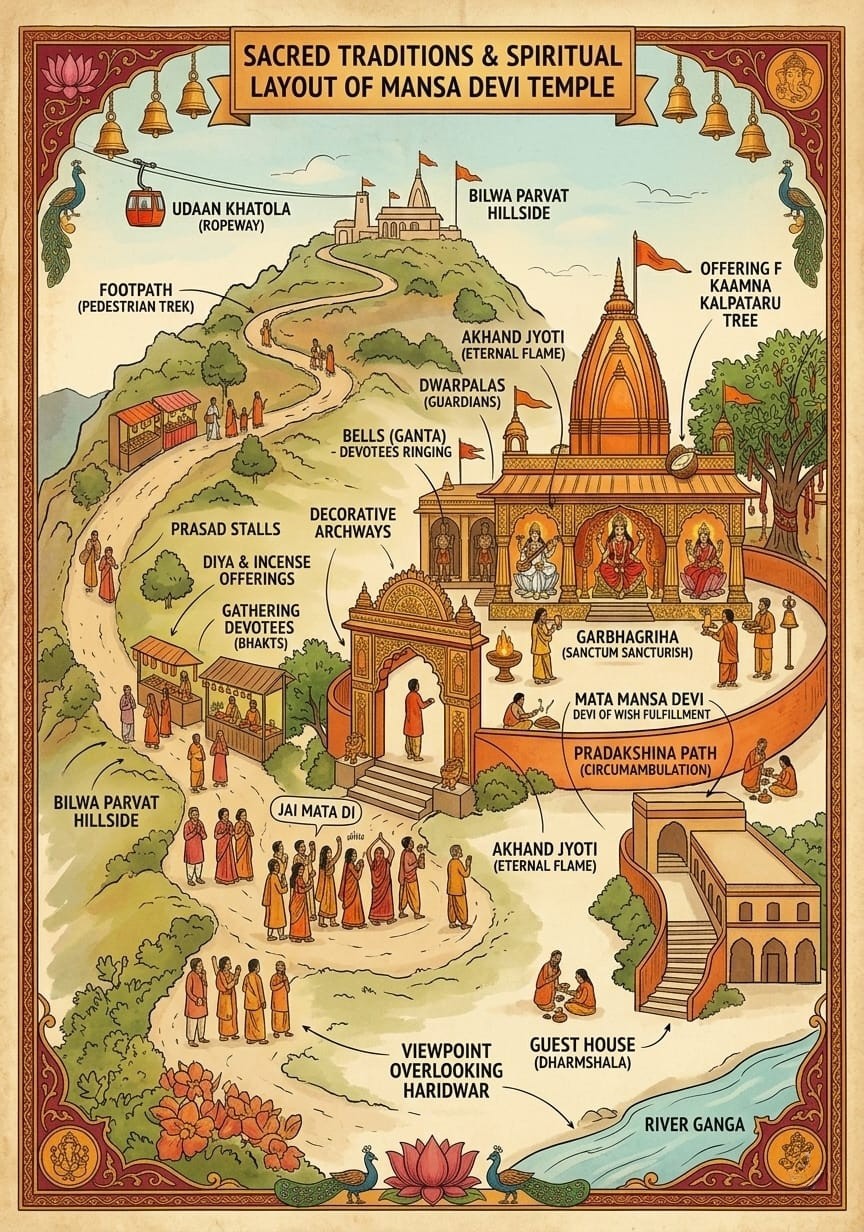
Mansa Devi Temple in Haridwar, a sacred hilltop temple of the Goddess Mansa. It fulfils devotees’ wishes and ranks among the most revered Siddh Peeths and Panch Tirths in the city.
In Mansa devi, Mansa, which means “wish”, is the Goddess of fulfilment and a form of shakti. Many believe she emerged from the mind of Lord Shiva and consider her the sister of the serpent Vasuki.
Traditions
A popular tradition involves tying a sacred thread to the branches of a tree in the temple while making the wish. While untying that thread after the fulfilment of the wish.
Deity:
The temple houses two idols:
(1)an idol with eight arms and
(2)the other idol with three heads and five arms.
Location:
Situated on Bilwa Parwat in the Shivalik hills of Haridwar, Uttarakhand
Mythology
Ancestral Tales
The Mind-Born Goddess: Her name originates from Manas (mind). Legend states she emerged from the mind of Sage Kashyapa (or Lord Shiva), symbolising the power of pure intention.
Queen of Nagas: She is the sister of Vasuki, the King of Serpents. Devotees worship her for protection against snakebites and “Nag Dosha.”
The Rest of Shakti: After defeating the demon Mahishasura, the Goddess rested atop Bilwa Parvat. Promising to fulfil the desires of her visitors.
Spiritual significance:
Siddh Peeth: Along with Chandi Devi and Maya Devi, she forms the spiritual triangle that protects Haridwar.
The Sacred Thread: The most famous ritual involves tying a red thread to a sacred tree while making a wish; devotees untie it once their prayer is answered.
Chandi Devi Temple
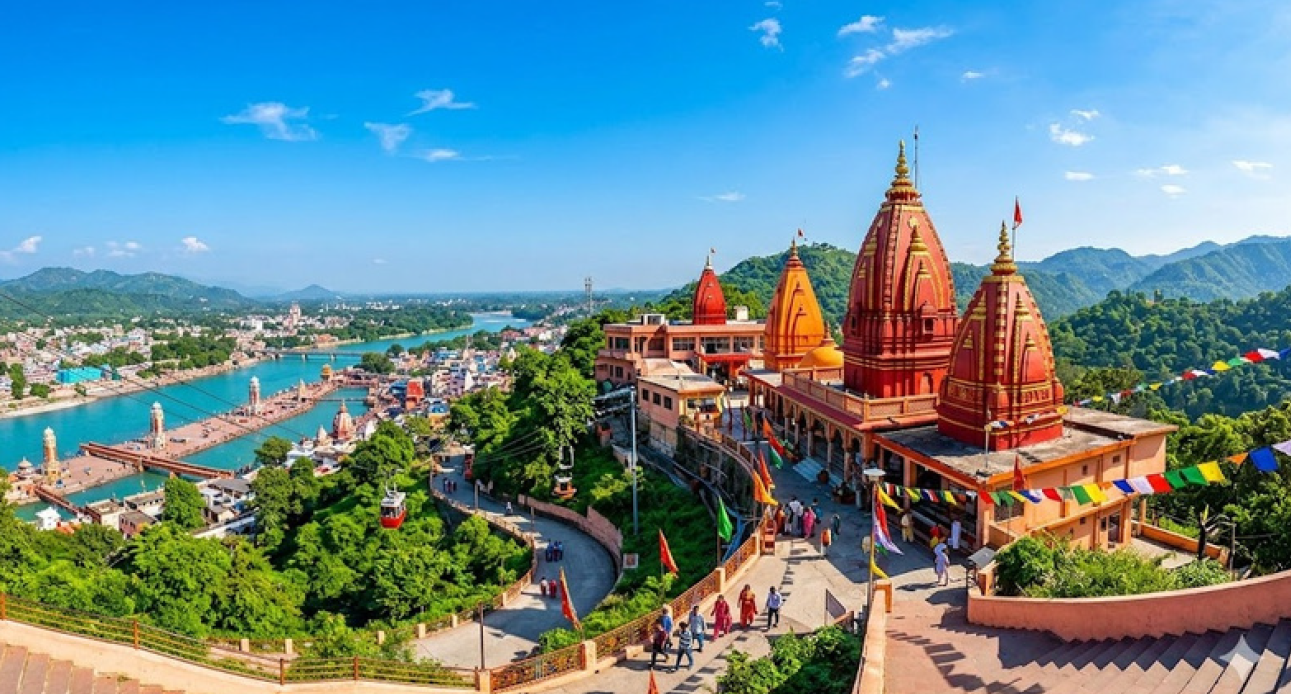
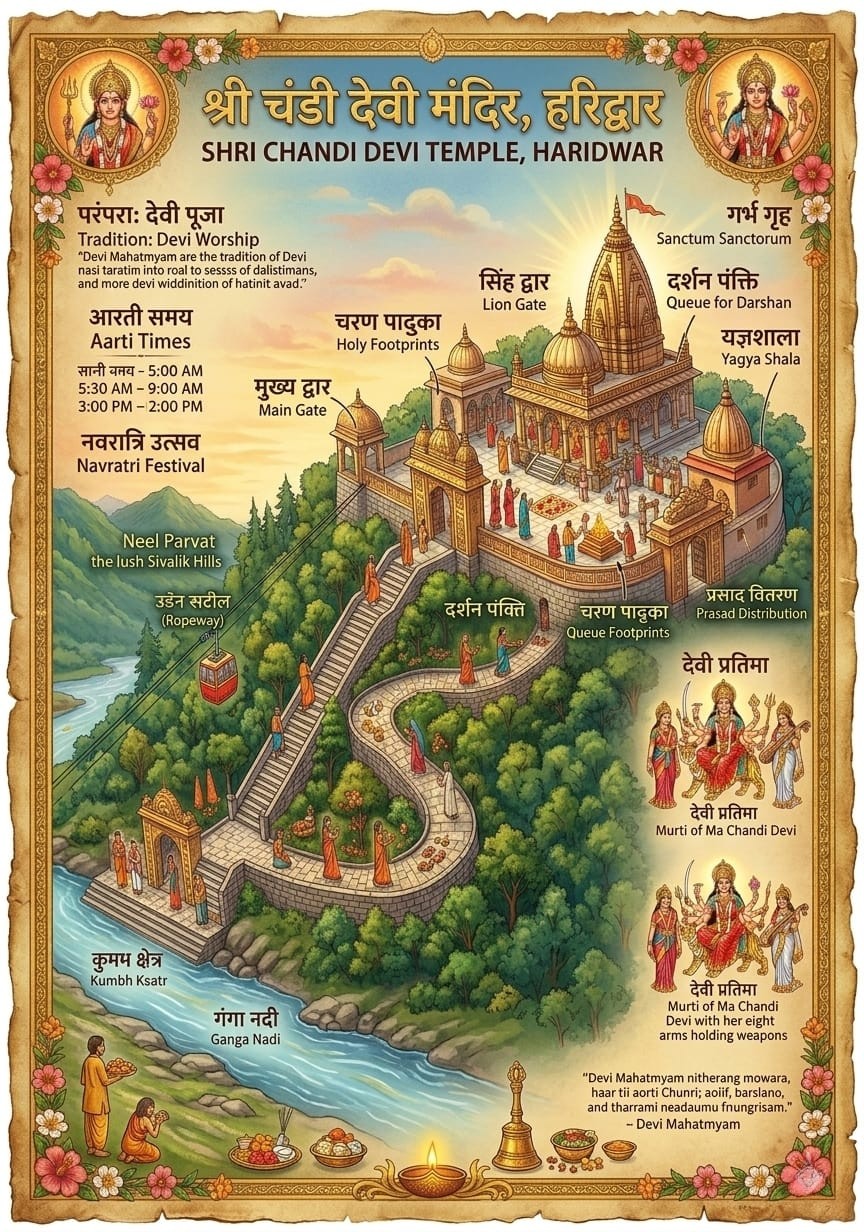
The Chandi Devi Temple, perched at the top of the Neel Parvat of the Shivalik Hills. It is one of the most powerful Siddh Peethas in North India. According to the Sacred Lore, the temple marks the spot where the Goddess Chandi rested after slaying the demon kings Shumbha and Nishumbha, who had terrorised the heavens.
Sacred Rituals (Pujas):
Abhishekam: A daily tradition where devotees bathe the idol with “Panchamrit” to symbolise purification.
Satchandi Havan: A powerful fire ritual (Havan) performed by priests to invoke divine protection and strength for the devotees.
Chandi Path: At the temple, devotees constantly recite the Durga Saptashati to remove obstacles and grant courage.
Deity:
Maa Chandi, a fierce form of Shakti. Adi Shankaracharya reportedly consecrated the idol in the 8th century.
Location: Perched atop Neel Parvat (2,900 ft), approximately 4 km from Har Ki Pauri.
Access: Reachable via a 3 km steep trek or a 5-minute ropeway (Udan Khatola) ride.
Mythology
The mythology of the Chandi Devi Temple centres on the battle between the Gods and the Demons (Asuras).
The Battle of Blue Mountain
According to the Devi Mahatmya, the demon kings Shumbha and Nishumbha had conquered the three worlds and dethroned Indra. In response, the Gods prayed to Parvati, who manifested as Goddess Chandi to restore cosmic order. The Slaying of Generals: The demons sent their chief generals, Chanda and Munda, to capture her. Chandi Devi engaged them in a fierce battle on Neel Parvat (Blue Mountain) and defeated them.
The Final Victory:
After killing Chanda and Munda, she eventually slew Shumbha and Nishumbha themselves.
The Resting Place: Legend says that after the exhausting battle, the Goddess rested at the very spot where the temple stands today. Worshippers honour her as Chandi Devi because she conquered the demons “Chanda” and “Munda” here.
Ancient Consecration:
While the battle is prehistoric, Adi Shankaracharya in the 8th century links the physical worship at this site. He is believed to have meditated on this peak . He established the original “Murti” (idol) to channel the Goddess’s fierce protective energy.
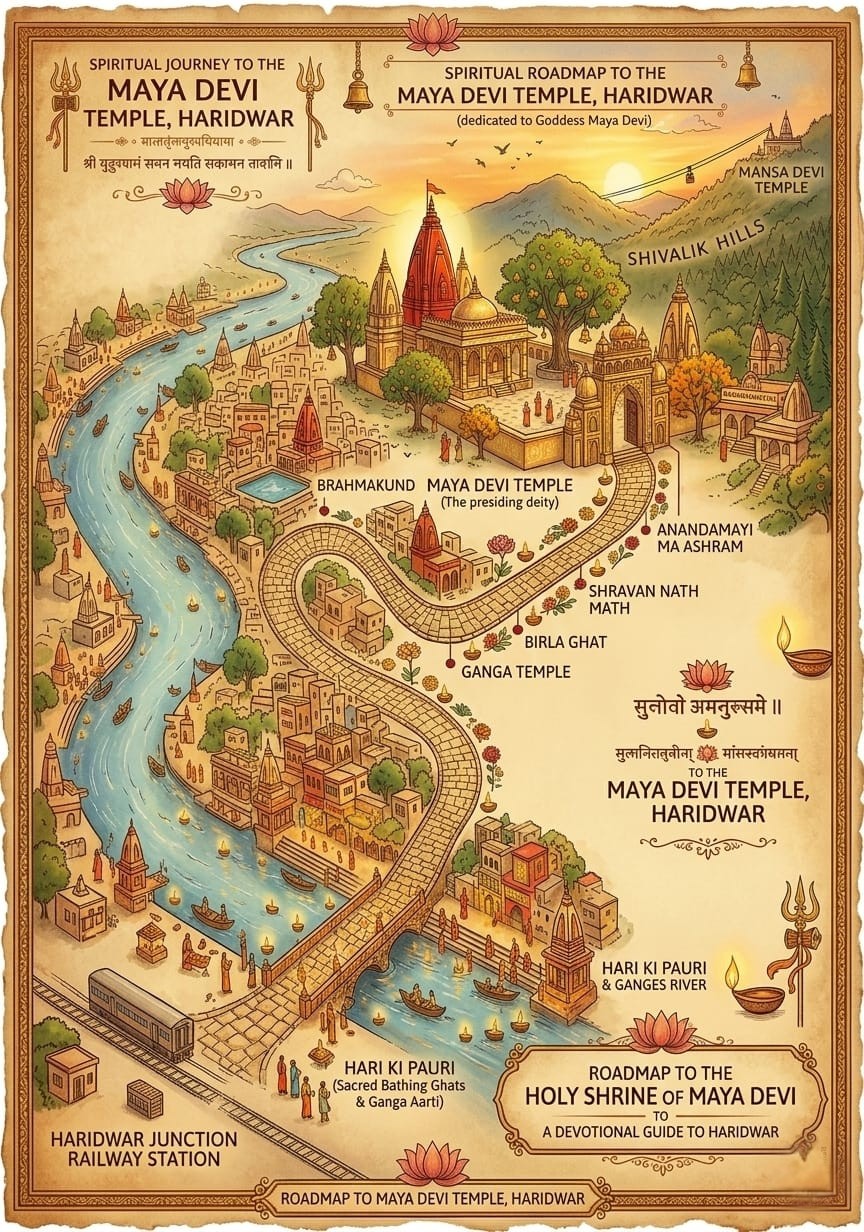
Maya Devi Temple
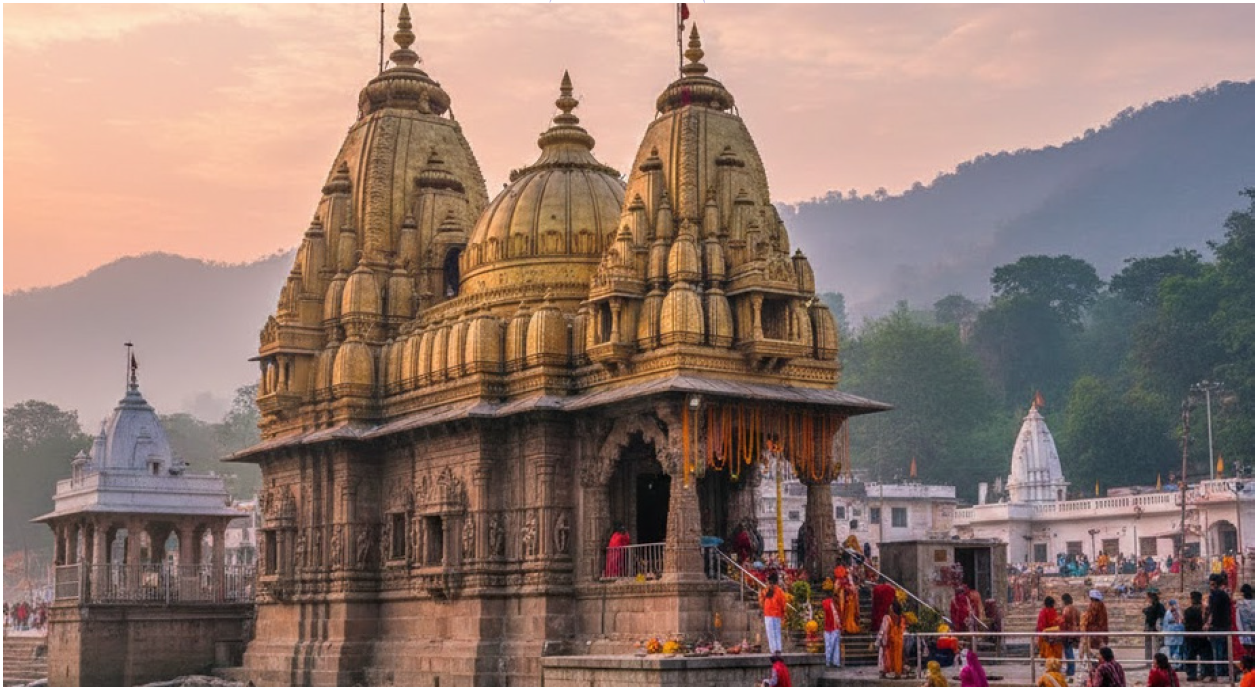
The Maya Devi Temple is one of the most sacred and ancient landmarks in Haridwar, dating back to the 11th century. Dedicated to the goddess Maya—an incarnation of Shakti. It holds immense spiritual significance as one of the three Siddh Peethas in the city, alongside Mansa Devi and Chandi Devi. Many believe the temple marks the spot where the heart and navel of Goddess Sati fell. Consider it the presiding deity of Haridwar, historically known as Mayapuri in her honour.
Historical Roots:
It is one of the few surviving ancient structures in Haridwar, showcasing classic North Indian temple architecture.
The Deities:
The inner sanctum houses the idols of Maya Devi, Goddess Kali, and Goddess Kamakhya.
Pilgrimage Importance: Devotees believe that no visit to Haridwar is complete without seeking the blessings of Maya Devi. Especially during the Kumbh Mela.
Mythology
The sacred texts of the Puranas and the concept of Shakti Peethas deeply intertwine with the mythology of the Maya Devi Temple in Haridwar. People believe this to be the spot where the heart and navel of Goddess Sati, an incarnation of Shakti, fell. According to legend, when Sati’s father, King Daksha, organised a yagna (sacrificial ritual). He insulted her husband, Lord Shiva, Sati jumped into the sacred fire in an act of self-immolation.
Distraught with grief, Lord Shiva carried her body and performed the Tandava, the dance of destruction, across the universe. To save the world from this devastation, Lord Vishnu used his Sudarshan Chakra to cut Sati’s body into 51 pieces. Which fell across the Indian subcontinent.
The spots where these parts landed became the revered Shakti Peethas. The Maya Devi Temple, marking the spot of her heart and navel, serves as a powerful source of divine energy and primarily grants the temple its supreme spiritual significance. In ancient times, people even named Haridwar Mayapuri in honour of this deity.
Daksheshwar Mahadev Temple
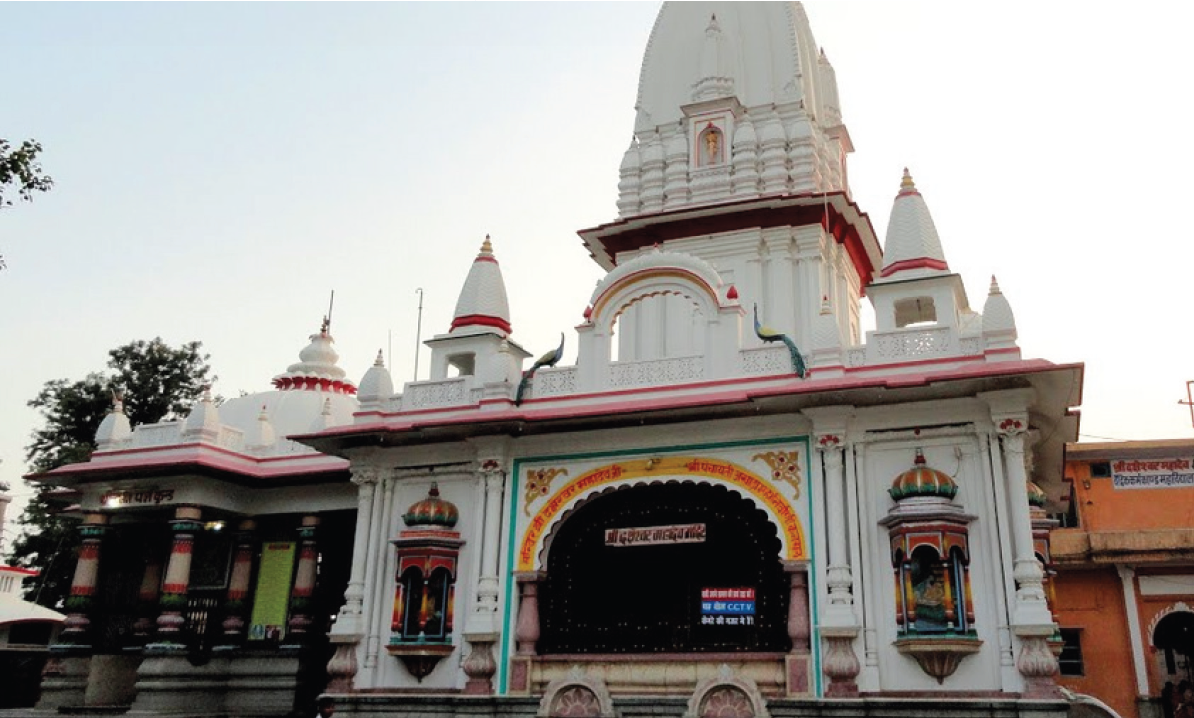
The Daksheshwar Mahadev Temple, located in the quiet town of Kankhal near the main ghats of Haridwar, stands as one of the oldest and most significant shrines dedicated to Lord Shiva. Queen Dhankaur built and rebuilt the temple in 1810 and 1962, on the ground of the legendary Daksha Yagna.
It serves as a powerful reminder of the deep mythological roots of Hindu culture, drawing thousands of devotees who come to pay their respects at this site of divine sacrifice and transformation.
Why It’s Special
- The Sacred Pit: The temple complex has the Yagna Kund, the sacrificial fire pit where Goddess Sati allegedly immolated herself.
- A Hub for Shiva Devotees: During the holy month of Sawan, pilgrims flock to the temple, as many consider it one of the holiest places to worship Lord Mahadev.
- Dashnaam Gosain Influence: The Mahanirvani Akhada currently manages the temple, maintaining its traditional rituals and sanctity.
Mythology
The mythology of the Daksheshwar Mahadev Temple centres on the legendary and tragic Daksha Yagna, a pivotal event in Hindu
scriptures. According to the Shiva Purana, King Daksha Prajapati, the son of Lord Brahma, organised a grand sacrificial ritual (yagna) at this very site in Kankhal. He invited all the gods and sages but intentionally excluded his son-in-law, Lord Shiva, whom he despised for his ascetic lifestyle. Despite Shiva’s warnings, his consort Sati attended the ceremony, only to face public humiliation from her father’s insults toward her husband. Unable to bear the dishonour, Sati immolated herself in the sacrificial fire.
The Divine Aftermath
The temple’s mythology continues into a tale of fierce destruction and eventual mercy:
Virabhadra’s Wrath: Upon hearing of Sati’s death, an enraged Lord Shiva created the terrifying warrior Virabhadra from a lock of his hair, who marched to Kankhal and beheaded King Daksha. The Goat’s Head: At the plea of the other gods, Shiva eventually showed mercy and brought Daksha back to life, replacing his severed head with that of a goat.
The Promise: Realising his folly, Daksha became a devotee of Shiva. Devotees say that Lord Shiva promised to reside in Kankhal every year during the holy month of Sawan, making this temple one of the most spiritually charged locations for Shivanite worship.
Bharat Mata Temple
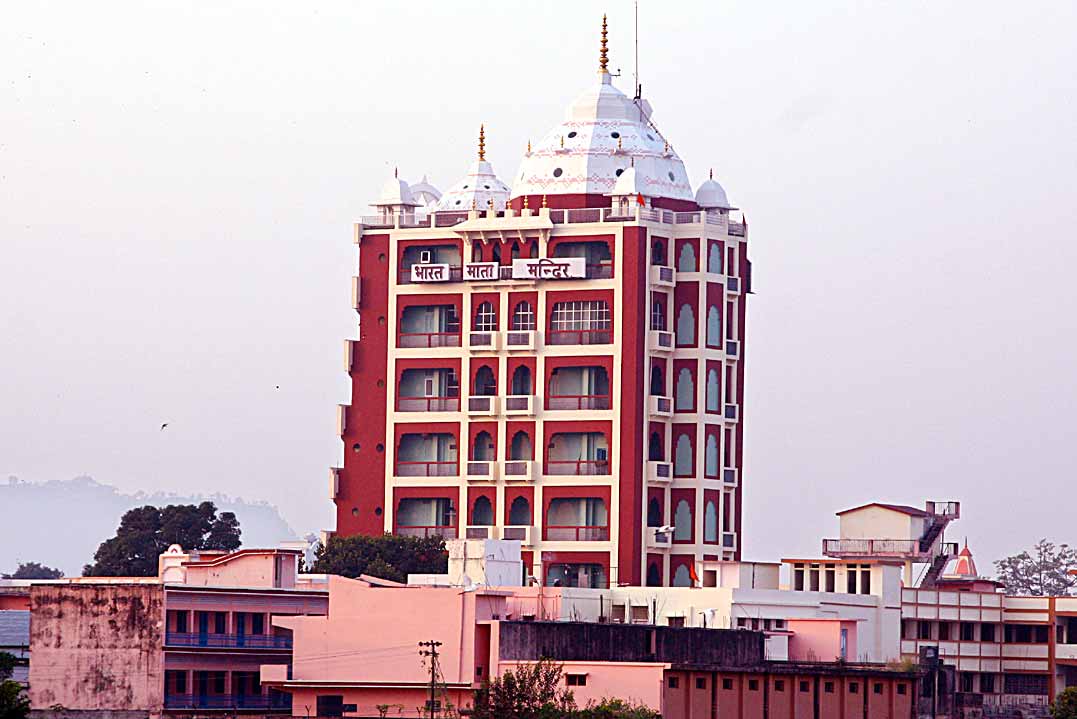
Located about five kilometers from Haridwar’s city centre, the Bharat Mata Mandir (Mother India Temple) is a significant and unique spiritual landmark that stands apart from the city’s ancient mythological temples. Unlike other temples, this one dedicates itself not to a single deity, but to Mother India as the divine personification of the nation.
Founded by the revered Swami Satyamitranand Giri and inaugurated by Indira Gandhi in 1983, the mandir serves as a multi-story symbol of national unity, patriotism, and religious harmony. The massive eight-story structure, rising over 180 feet, features the distinctive golden spire and multi-level design seen in contemporary Haridwar temple architecture, similar in grand scale and golden finish to the Daksheshwar Mahadev Temple. Each unique floor meticulously showcases a different facet.
Facet of Indian heritage:
- 1st Floor (Devi Mandir): Houses a massive relief map of undivided India and a statue of Bharat Mata.
- 2nd Floor (Shoor Mandir): Pays tribute to the nation’s legendary freedom fighters and heroes.
- 3rd Floor (Matru Mandir): Celebrates the contributions and sacrifices of key women in Indian history.
- Other Floors: honor saints, leading philosophies, and all religions practiced in India.
People widely celebrate the temple for its inclusive ethos and stunning panoramic views of the Ganges River, the distant Himalayas, and the vibrant Haridwar landscape from the upper terraces.
Nationalist Spritualism
Unlike the ancient temples of Haridwar rooted in the Puranas or the Vedas, the Bharat Mata Mandir lacks traditional mythology involving ancient deities or prehistoric legends. Instead, its “mythology” is a modern, nationalist spiritualism that elevates the geography of India to the status of a living Goddess. The temple’s core belief centers on Desh-Devoti (Patriotism as Devotion), where citizens worship the land as their mother.
The idol of Bharat Mata, depicted as a four-armed goddess in saffron robes, holds a book, sheaves of rice, a mala, and a white cloth at the heart of this modern mythology. This imagery symbolises the four pillars of Indian identity: Learning, Food, Devotion, and Liberation.
The “sacred geography” of the temple is anchored by a massive relief map of India carved in marble on the ground floor. For pilgrims, walking around this map is considered a form of Parikrama (circumambulation), turning a geographical study into a high spiritual act. By blending the traditional structure of a Hindu temple with the history of freedom fighters and saints, the Mandir creates a new “myth” where the preservation of the nation’s culture is seen as the highest form of religious duty.
Har Ki Pauri
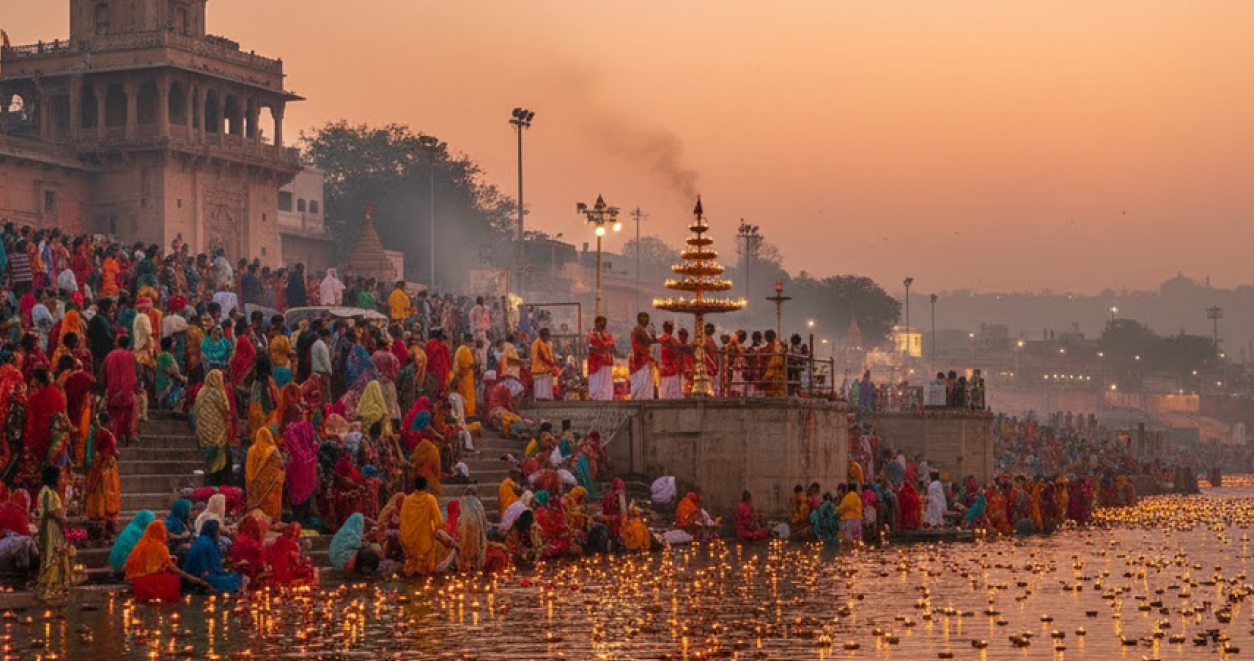
Har Ki Pauri, meaning “Steps of the Lord,” is the beating heart of Haridwar and one of the most sacred river ghats in India. It is believed that Lord Vishnu left his footprint on a stone wall here, and it is the exact spot where drops of Amrit (the nectar of immortality) fell during the celestial churning of the ocean. Every evening, the ghat transforms into a sea of gold during the Ganga Aarti, as hundreds of leaf-boats with flickering lamps are set afloat on the river. For pilgrims, a dip in the holy waters here is not just a ritual, but a spiritual cleansing believed to wash away sins and grant salvation.
Quick Facts
- The Landmark: The iconic Clock Tower stands as a silent witness to the millions of devotees who visit annually.
- Brahmakund: The most auspicious section of the ghat where the evening prayers take place.
- The Experience: Famous for the rhythmic chanting, ringing bells, and the breathtaking sight of the “river of lights.”
Mythology
The mythology of Har Ki Pauri is centred around the celestial event of Samudra Manthan (the churning of the ocean) by the gods and demons. According to the Puranas, when the pitcher of Amrit (the nectar of immortality) emerged from the ocean, a divine struggle ensued.
During this chase, four drops of the nectar fell upon Earth—at Prayagraj, Nasik, Ujjain, and specifically at the Brahmakund in Har Ki Pauri. This makes the water here spiritually “charged” with the essence of eternal life, which is why the Kumbh Mela is celebrated here every twelve years.
Another profound legend gives the place its name, which translates to “Footsteps of the Lord.” It is believed that Lord Vishnu visited this spot during the Vedic age and left his footprint on a stone wall within the precincts of the ghat.
Furthermore, the area is tied to the penance of King Bhartruhari, the brother of King Vikram Aditya, who meditated here for years. In his honour, the steps (Pauri) were originally constructed, cementing Har Ki Pauri as the gateway where the celestial world meets the earthly realm.

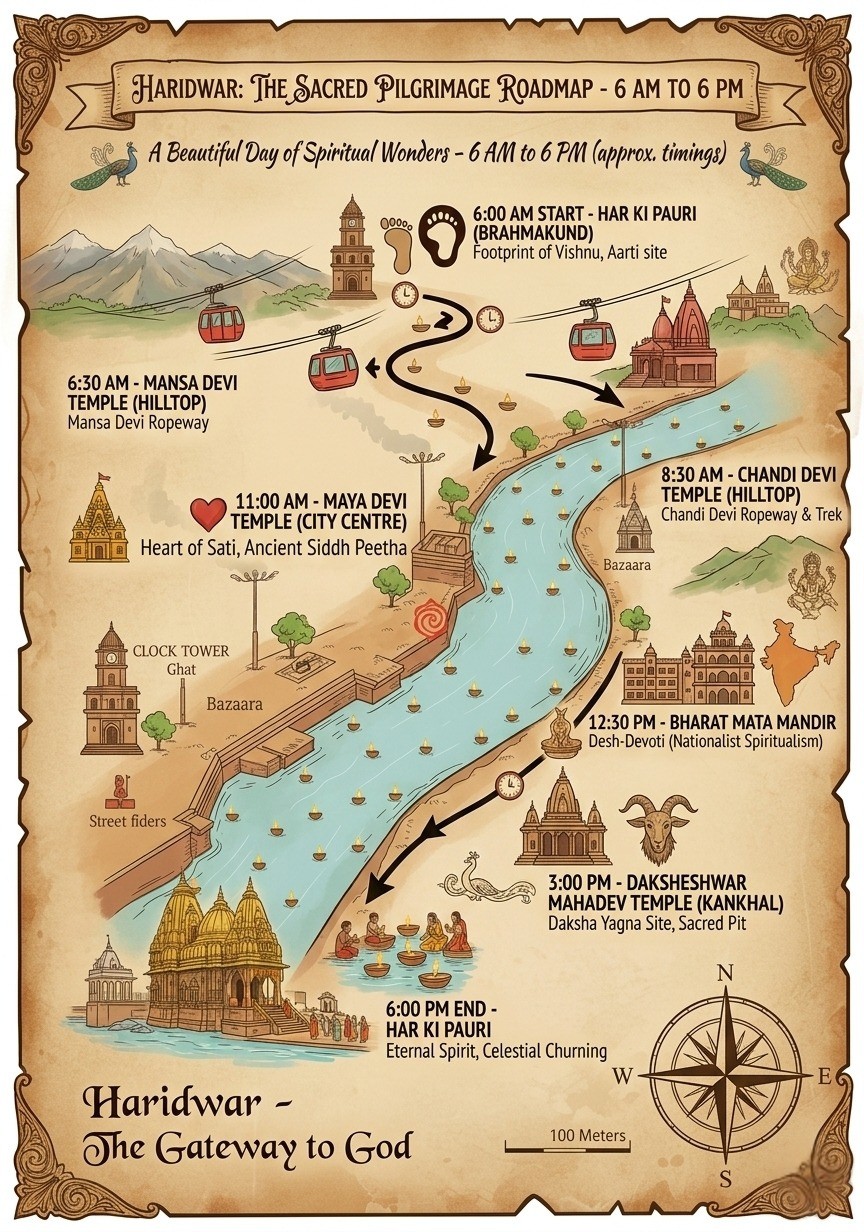
In conclusion, Haridwar is a city where every stone tells a story of devotion. Every step along the Ganges is a journey closer to the divine. From the ancient Shakti of the Maya Devi and Mansa Devi temples to the powerful energy of Daksheshwar Mahadev, and the modern patriotic spiritualism of Bharat Mata Mandir, these sacred sites offer a profound experience for every seeker.
Whether you visit to wash away sins at Har Ki Pauri or to seek blessings from the myriad deities, the spiritual legacy of Haridwar leaves an indelible mark on the soul. We hope this guide has provided you with a meaningful understanding of the legends and significance of these revered temples, helping you connect more deeply with the eternal spiritual light of the “Gateway to God.”
THANK YOU
Buy the Essence of Lord Shiva Itself here at SUKH.