Why did Lord Krishna built City of Dwarka?
Kamsa sent so many asuras to Vrindavan in an attempt to kill Sri Krishna and Sri Balarama. They decided to invite them to Mathura for a wrestling match with the great demons Chanura and Mustika. At that time, Krishna came to Mathura. He and Balaram killed Chanura and Mustika, and then they killed Kansa. After they killed Kansa, Kansa had 2 wives, Asti and Prapti. Who were the daughters of King Jarasandha, a great demon of the Magadh province. They went back to their father, Jarasandh, feeling grief-stricken and with broken hearts.
They began to weep and proclaim to their father that Kansa was such a noble, pious, righteous man. This Krishna was such a rogue, he came, and when our husband Kansa was minding his own business. He was not aware that Krishna jumped on him and killed him by all unfair means. We will not be satisfied until we avenge our husband’s death. So Jarasandha made a vow to destroy Krishna and destroy the entire Yadu dynasty. He was a very powerful asura. So, he mobilised twenty three akshahouni division of soldiers. Comprising all demons from the entire world, to help him conquer Krishna.
As you know, the battle on Kurushetra killed so many soldiers. But there were only eighteen akshahounis divisions of soldiers on both sides together. Jarasandha mobilised twenty-three akshahouni divisions, and they attacked Mathura and Krishna. Krishna killed all of his army, deeply uprooted them, and destroyed everyone except Jarasandha. He allowed Jarasandha to escape. He again went to mobilise all the demons from all over the world to come up with a huge army. To again attack Mathura. Krishna destroyed all his armies. He did this seventeen consecutive times.
Now one may ask why Krishna killed his whole army but never would kill Jarasandha. The sages explain this in a shloka from The Bhagavad Gita 4.8 shloka. “Paritranaya sadhunam, vinashaya cha dushkritam, Dharma-samsthapana-arthaya, sambhavami yuge yuge”. It declares that Lord Krishna descends in every age to protect the righteous (sadhunam). Destroy the wicked (dushkritam), and firmly establish dharma (righteousness).
Krishna comes for the purpose of protecting his devotees and annihilating the miscreants, the demons. He knew that Jarasandha was such a popular and influential demon. He was getting demons from all over the world and bringing them right to Mathura. So instead of Krishna travelling all over the world to kill all demons. He knew all he had to do was kill them and let Jarasandha bring them. Whoever remained would kill them all, and in this way, the demons approached his door.
There was a personality of the name Garga. One time, it so happened that some of the members of the Yadu Dynasty ridiculed him and laughed at him. So he did tapasaya to Lord Shiva for a long time, many long years. He begged for a benediction that he would have a child. Who would create great fear and anxiety in the Yadus. So with the benediction of Lord Shankar, he begot from a woman from the Yavana class. A sect most uncivilised section of society. A son whose name was Kalayavan, who was a very powerful demon. Because he belonged to a Yavana untouchable class, people avoided going close to him, considering him very uncivilised.
Kalayavan mobilised a huge army of barbarians. Jarasandh arranged that one would attack from the east and one would attack from the west simultaneously. So Kalayavan comes with his armies from one side of Mathura and challenges Krishna to fight. Krishna realises that while I am fighting with his armies, Jarasandh will come from the other side. Then the citizens of Mathura will be in a very difficult position.
It would be very uncomfortable for them. So he spoke with Balaram about this, and he made a plan. While all the citizens of Mathura were sleeping, Krishna called for Visvakarma, the architect of the demigods. Krishna told him to build a beautiful city within the sea. The city had a boundary wall around it, which was 96 miles. Visvakarma may build such a wonderful, beautiful, incredible palace that nobody would have seen. There are beautiful, wide highway lanes that imported many beautiful flowers like the parijata from the heavenly places.
Beautiful palaces all bedecked with marble and all precious jewels and gold and silver. They even brought the Sudharma, the administrative parliament building of the heavenly planets of Indralok. They brought it down to be the capital of Dwarka. After beautifully constructing everything, all the 33 crores of demigods contributed or gifted to make Dwarka beautiful. While all the inhabitants of Mathura were sleeping, by the yogamaya potency. Krishna transported everyone to Dwarka. So when they woke up in the morning, they were living in this beautiful city in the middle of the ocean.
Krishna was confident that the ocean itself protected this very fortified fort. He could attempt to deal with these demons. So when Kalyavana approached Krishna, he just walked right by him, and Krishna just walked very fast, and he was threatening, “You coward, why don’t you stand and fight?” Krishna kept walking, and he walked into a cave. Kalyavana was thinking what type of nonsense coward He is and now hiding in a cave.
When he entered the cave, he saw a body sleeping on the ground. He thought him to be Krishna, what an insult; I challenged him to fight, and he went to sleep. He kicked his body hard, but instead of Krishna, it was the great king Muchukunda who arose in anger. He glared at Kalyavana, burning him to ashes with his fierce gaze.
Then Muchukunda told Krishna that he was not Krishna but a great king of the name Muchukunda, who immediately arose and looked at Kalyavana with great anger and with his eyes, he burnt Kalyavana into ashes. Then Muchukunda told Krishna that he defended the demigods for many long years against the demons until Kartikeya, the son of Shiva, was born.
At that time, they told me that they do not require you anymore, we will give you any benediction for your seva. He said the only benediction I wanted was to sleep. I haven’t slept for years, and he feared that if any other problem would take place, Indra and the demigods would wake him up, so he said that I want a benediction that if anyone wakes me, I will burn into ashes with my eyes.
Krishna was incredibly clever, yet Muchukunda, his devoted follower, longed for Krishna to awaken him so he could return to the spiritual realm. However, if Krishna woke him, Muchukunda would look at him, and if Krishna did not burn him to ashes, then it would have made the demigod liars. If Krishna burnt him to ashes, then it would not be possible for Muchukunda to recognise him as Krishna.
Therefore, he needed someone else to wake him up—someone whose glance would burn him to ashes.. Besides, Kaalayavana was a yavana and therefore it was below the dignity of Krishna to touch him with His own body or any of His weapons. He arranged for Muchukunda to burn him with his glance, then offered Muchukunda a blessing. Muchukunda simply asked, “Let me always remember you with love and devotion, and let me forever serve your devotees.”
Then Krishna went back to Mathura. And at that time, when Jarasandha attacked again, Krishna just walked away, and he started chasing after him, and this time, Balaram was along with him. Krishna Balaram were walking and Jarasandha was running as fast as he can with all of his armies, akshahounis divisions of soldiers but no matter how much they ran even with their chariots and elephants and with full speed Krishna and Balarama were walking they could not reach him and Krishna walked into a big mountain.
The mountain stood 80 miles tall, and despite Jarasandha and his armies thoroughly searching it, they could not find Krishna. Convinced he had not escaped, they set the entire mountain ablaze, believing no one could survive. However, Krishna and Balarama leapt from the top, soaring 80 miles down to the ground, evading the flames.
Sri Krishna Balaram Ki Jai. This mountain, known as Mount Pravarshan, is still called Raivata Mountain in Gujarat today. Meanwhile, Jarasandha, convinced they were dead, held grand celebrations, delighting in the news of Krishna and Balarama’s demise. Because Krishna ran from the front of Jarasandha, he gave the name Ranchor. Ranchor literally means the one who ran from the battle like a coward, but when Krishna ran from battle as Ranchor, He is actually a demonstration of His opulence, aishwarya of renunciation. Krishna does not care what people think of him in this regard.
He is a renunciate. He allowed everyone to think that he is coward running way form battle because he had a very special purpose. What was His purpose? He wanted to reach Dwarka quickly, knowing that Rukmini would soon meet him to elope. Realising that engaging in a war with Jarasandha might delay him, he swiftly walked away, jumped over the fire, and entered Dwarka.
Why did Dwarka drown in the sea?
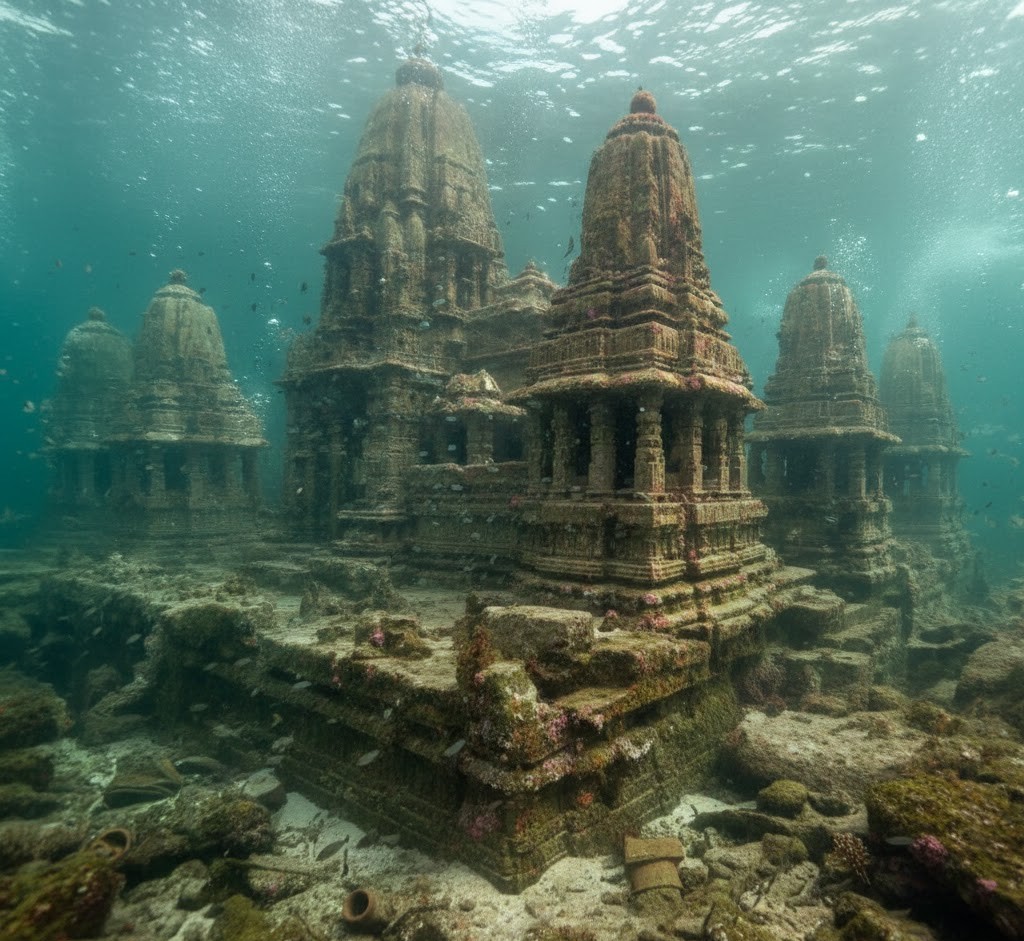
Dwarka is the most famous legendary underwater city, and one can read its history and prevalence in the scripture of the Mahabharata. Like Atlantis, Dwarka is said to have sunk beneath the sea at some point in the past. However, you can find remains of the city underwater, unlike Atlantis, whose remains were never discovered.
In the tale of the Mahabharata, following the war between the Pandavas and the Kauravas, Queen Gandhari cursed Lord Krishna and his Yaduvansha clan.
After the war, Gandhari was distraught. When Krishna visited her to offer condolences, she accused him of being able to prevent the war but choosing not to, thereby allowing the Kauravas to die. Gandhari cursed that 36 years after the Kurukshetra war, Krishna’s Yadava clan would meet the same fate as the Kauravas—dying in a civil war. She also cursed that Krishna himself would die a lonely death in the forest
As a divine being, Krishna recognised that the Yadavas had grown arrogant and reckless. He accepted the curse, fully aware that his purpose on Earth—establishing dharma and relieving the burden of evil rulers—had been fulfilled.
Lord Krishna, stricken with grief, went to the forest, where he met his fateful end with an arrow mistakenly shot by a hunter. After Lord Krishna’s passing, Arjuna evacuated the remaining inhabitants of Dwarka, after which the city was consumed by the sea. A separate curse from the sages also ensured this destruction, prompting Samba (Krishna’s son) to create a weapon that led to the clan’s demise.
SAMBA AND THE END OF YADUKUL
SAMBA’S BIRTH
Jambavati, the second consort of Lord Krishna, was unhappy. She realised that all of Krishna’s wives were blessed with many sons, while she had none. Hence, she demanded that Krishna have a son who would be as handsome as his firstborn, Pradyumna.
Krishna went to sage Upamanyu’s ashram in the Himalayas and, upon his advice, started to pray to Lord Shiva, performing extreme penance for six months. Pleased with his dedication, Lord Shiva appeared before him as Samba (Ardhanarishvara – the half-male, the half-female form of Shiva-Shakti) and asked him for a boon. Lord Krishna requested a son for Jambavati, and this wish was granted. Lord Shiva further declared that the boy would be one of his eleven Rudras, destined for destruction, and Krishna accepted this fate. Samba grew up to look exactly like Krishna and was as notorious and naughty as Krishna was in his younger days.
When Duryodhana arranged a swayamvara for his daughter Lakshmanaa, Samba wanted to marry her even though she was not inclined to the match. He went anyway and abducted Lakshmanaa forcefully from the palace. He defeated many Kuru Maharathis who pursued him, but was eventually caught and put in prison.
When the swayamvara was rearranged, none of the princes was willing to marry an abducted girl, fearing they couldn’t defend against an attack from the Yadavas. When Balarama came to Hastinapur to rescue his favourite nephew, the Kurus refused his request. Enraged, Balarama began smashing the palace, and only Duryodhana’s agreement to marry his daughter to Samba calmed him down.
Samba was very proud of his looks and his resemblance to his father. He used to fool his stepmothers and play pranks on them. One day, he happened to sage Narada for his looks. The sage who wasn’t good-looking felt humiliated and decided to teach Samba a lesson. He lured Samba to the private bathing pool where his stepmothers were taking baths. Finding an intrusion on their privacy, they all complained to Krishna. Narada also added fuel to the fire. Krishna had tolerated a lot of his pranks on his wives before, but this was beyond him. He was mortified to learn that his son had become a “peeping tom” and cursed him to suffer from leprosy.
When Samba pleaded innocence and explained it to him, Krishna found it to be true but was helpless since the curse couldn’t be reversed. He suggested Samba, asking him to pray to Lord Surya since he would be the only one who could cure him of the deadly disease.
The Samba Purana narrates this incident a bit differently Sage Durvasa, offended by Samba’s teasing about his looks, cursed him to suffer from leprosy.
Samba prayed to the sun god for 12 years in the temple he built in Mitravana, located on the banks of the Chandrabhaga River (now the Chenab River, formed by the confluence of the Chandra and Bhaga rivers). This site was once home to the Multan Sun Temple. Both the sun temple at Konark and the one at Multan, formerly known as Kashyapapura, are attributed to Samba.
Some writings also suggest that he had performed this 12-year penance on the banks of Chandrabhaga (in Odisha).In Odisha, people celebrate this day as Samba Dashami, marking the 10th day of the Shukla Paksha in the month of Pausha. On this day, mothers pray to Surya for the health of their children.
After the Mahabharata war, Gandhari lost all her 100 sons, and the Pandavas mourned the loss of their 5 sons as well. Believing Krishna was responsible for the devastation, Gandhari cursed him, proclaiming that he, his city, and all his subjects would face destruction. Krishna accepted the curse.
The Mausala Parva, the sixteenth book of the eighteen-part Mahabharata series, reveals that Gandhari’s curse came to fruition 36 years after the great war ended. Despite the kingdom’s prosperity, the youth had grown frivolous. One day, several Rishis—Vishwamitra, Durvasa, Narada, and Vashista, among others—visited Dwarka for an audience with Krishna. Samba, dressed as a pregnant woman, along with his friends, asked the Rishis to predict the baby’s gender.
One of the rishis could see through the prank, and in a fit of rage, curses Samba that he’ll give birth to an iron mace that shall destroy the entire clan.
True to his words, Samba gave birth to an iron mace the very next day. Upon hearing this, King Ugrasena, Samba’s great-grandfather, suggested he powder the mace and throw it into the Prabhas sea (present-day Arabian Sea). Some of the powder washed ashore and grew as iron grass, while others ended up in a fish, forming a small piece of metal. A hunter named Jara caught this fish.
It is with this grass that inebriated Yadava clan members kill each other, and only a few escape. Balaram, who had retreated before the start of the fight. Krishna, Vabhru, Daruka (Krishna’s charioteer). Krishna sends Daruka to inform the Pandavas and seek Arjuna’s help. He sends Vabhru to protect the ladies of the kingdom from robbers who would be tempted by all this mishappening; however, as soon as he starts moving, an iron bolt impales Vabhru, killing him immediately.
Krishna goes to Dwarka to console his father Vasudev, and he returns to Balarama in the forest and sees him preparing to depart the world through yoga. Krishna, who had foresight about all of this from before, concludes that the hour of his departure has also come. He lies down to rest behind a thick bush.
Mistaking his two toes for the ears of a dove, Jara, the hunter, shoots an arrow at him, with metal from the fish’s stomach attached to its tip. This mortally wounds Krishna, and upon seeing his wrong shot, Jara touches his feet. (Jara was reborn as Biswa Basu, the tribal chieftain who found the Nilamani and wascustodian)
From Sarala Das’s version of the Mahabharata (Sarala Das translated the Mahabharata into Odia), we come to know of a disconsolate Arjuna who comes along and tries to cremate his friend. But Krishna’s heart doesn’t burn. A divine voice echoes from the heavens. It tells Arjuna to throw Krishna’s heart into the ocean tied to a log. Over aeons, this log floats all the way around from the west coast of Dwarka to the east coast, where Puri is located.
The Lord has arrived on the shores of Puri!
SUBMERGED DWARKADHEESH NOW A DAYS
A nine-member team from the underwater archaeology wing (UAW) of the ASI is conducting a new study with onshore and offshore expeditions at Dwarka and Beit Dwarka in Gujarat. They aim to search for, document, and study submerged archaeological remains, as well as to determine the antiquity of the recovered objects through scientific analysis of sediments, archaeological, and marine deposits, according to a senior official.
In February, a five-member team from the ASI conducted a brief fieldwork in the south of Gomati Creek, situated on the eastern side of Dwarka. They aimed to inspect previously explored areas and assess their current condition. It also aimed to identify probable areas for further investigations and study. Archaeologists explored the selected area and photographed important features.
Dwarka is an important place from a historical, archaeological and cultural point of view. Researchers have frequently explored Dwarka, as ancient literature prominently mentions it. It has remained a significant part of the cultural history of India. “Given its importance, historians and archaeologists have explored and researched Dwarka in the past as well,” said Prof. Alok Tripathi, Additional Director-General of the ASI and leader of the excavation, in an interview with The Hindu.
The ASI’s Underwater Archaeology Wing carried out systematic archaeological investigations from 2005 to 2007 at Dwarka. These investigations, both onshore and offshore, revealed important archaeological remains including ancient sculptures, stone anchors, and other objects of historical importance. Scientists surveyed a large area, but the ASI archaeologists and Indian Navy divers conducted underwater archaeological excavations in a limited section. They marked the excavation area and carried out systematic dives. During the excavation, they cleaned scattered submerged remains covered by vegetation and a thick calcareous deposit. The excavation revealed clusters of submerged remains
In 2007, archaeologists also chose a small area near the northern gate of the Dwarkadheesh temple for the excavation. The team conducted the entire excavation meticulously to document antiquity in situ. They excavated a deposit of about 10 meters, with 26 layers. The excavation recovered antiquities such as iron objects, beads, copper objects, rings, etc. Besides, researchers examined and studied the potteries recovered during the excavation thoroughly.